
Stratosphere
AI-Powered Airline Operations Intelligence Platform
Senior Product Designer | 2024–2026
Designed a unified operational intelligence platform to consolidate fragmented airline systems into a single, real-time decision layer supporting 500+ simultaneous flights.
Reduced cognitive load for Operations Control Center (OCC) teams while introducing AI-assisted natural language exploration within structured operational workflows.
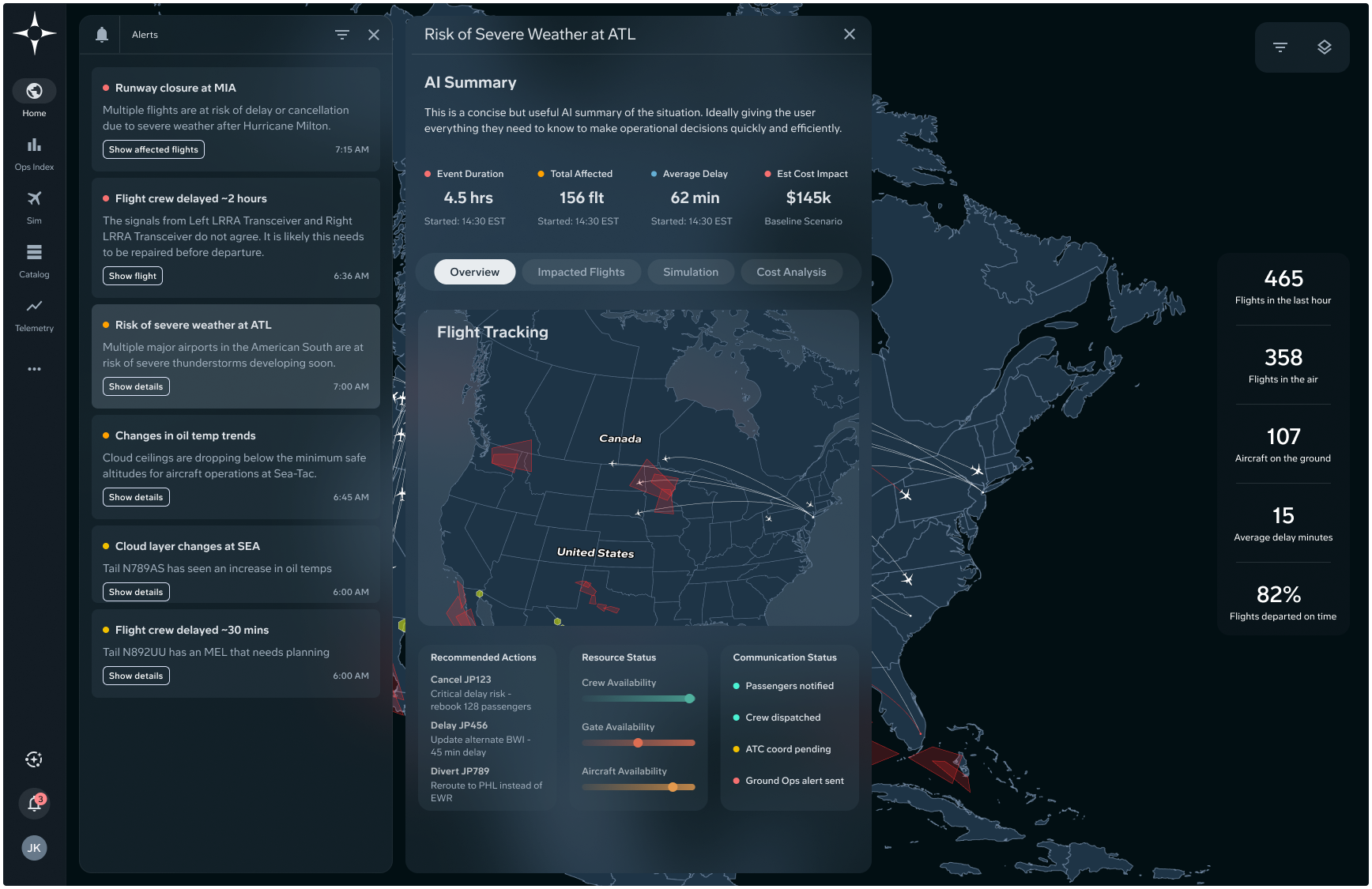
A unified spatial interface providing OCC teams persistent visibility across 500+ simultaneous flights, with AI embedded directly within operational context
Stratosphere unified fragmented operational systems into a single intelligence layer for real-time airline decision-making.
01
Unified Operational Systems
Consolidated fragmented crew, network, weather, aircraft, and analytics systems into a shared operational foundation enabling cross-functional visibility and future modernization.
02
Real-Time Decision Support
Enabled OCC teams to manage 500+ simultaneous flights with live spatial awareness, structured KPI benchmarking, and AI-assisted anomaly detection.
03
AI-Enabled Exploration
Introduced conversational AI as an embedded control layer, allowing OCC users to explore operational scenarios and surface insights without disrupting workflow continuity.
The Challenge
Airline operations depend on continuous coordination across crew, network, weather, aircraft, and airspace systems. While a global data infrastructure aggregated this information into what leadership referred to as a centralized “Knowledge Lake,” the OCC experience remained fragmented.
OCC teams relied on multiple legacy tools with limited interoperability. Critical decisions required switching interfaces, manually reconciling data sources, and interpreting rapidly evolving conditions under pressure.
As operational scale increased, so did cognitive load, decision latency, and risk exposure.
The architecture supported intelligence at scale. The experience layer did not.
Stratosphere was conceived to translate that complex data ecosystem into a unified, real-time operational intelligence platform designed specifically for OCC decision-making.
My Role
Led end-to-end product design from early concept through high-fidelity prototyping and customer validation, shaping the core interaction model of the platform.
Defined the structural framework for real-time operational monitoring, simulation workflows, and embedded conversational AI within a live spatial interface.
Partnered closely with product leadership, engineering, and aviation domain experts to align experience decisions with system architecture, global data constraints, and operational risk factors.
Established reusable interaction patterns, hierarchy standards, and shared principles that influenced emerging UX standards across adjacent Jeppesen operational systems.
Design Approach
Translated a complex global data ecosystem into a cohesive intelligence layer by defining consistent hierarchy, shared interaction patterns, and persistent spatial context across views.
1.
2.
System Unification
Cognitive Load Reduction
Designed layered information structures that surfaced high-risk conditions first while preserving access to detailed operational data. Prioritized clarity over density in high-stress OCC environments.
Integrated conversational AI as an embedded control layer within structured workflows rather than a standalone chat interface. Enabled seamless pivoting between spatial context and natural-language exploration without disrupting decision flow.
3.
AI as Control Layer
AI embedded within structured operational workflows.
Designed adaptive views and scenario modeling tools supporting varied OCC roles, from network control to executive oversight, while preserving a unified core architecture.
4.
Multi-Role Considerations
Impact & Influence
Stratosphere established a unified intelligence foundation for modern airline operations, consolidating fragmented OCC systems into a scalable experience designed for real-time coordination.
The platform was validated with Indigo, India’s largest airline, where an integrated AI-assisted Airport Status Dashboard entered production.
Beyond individual features, Stratosphere influenced emerging UX standards across Jeppesen’s operational ecosystem, establishing reusable interaction patterns and structural principles intended to support future modernization efforts.
This initiative demonstrated how AI could function as an embedded decision-support layer within live operational workflows, shaping internal thinking around the role of AI in aviation operations.